Monday, August 1, 2011

The Love Story begins at the Wedding

The idea that the reason to get married is to express your love for each other – or worse still to have a good knees-up with your friends – is a modern nonsense. Love is an important part of marriage for sure, but it is not a mandatory prerequisite. After all, real-life marriage is not a Hollywood movie, nor a Cinderella-esque fairytale where the love story ends at the wedding. We've got it backwards: the love story begins at the wedding and ought to grow. And it's here that we seem to have got mixed up as a modern society.

The wedding is not the marriage. The wedding is a gateway to marriage, a formalised written commitment. Contractual agreements in personal relations are underrated these days. You wouldn't buy a house or start a job without a contract, but we have romantic notions that a verbal declaration of love is sufficient to entrust our life, heart, emotional and spiritual wellbeing in another person.

Formal, written, structured agreements do have an impact on individuals. Harriet Baber says security is the main reason for marriage, but her argument is a negative one, giving security against what she sees as the minus points of singledom. But I'm arguing that commitment and contracts encourage a more positive state for the couple – otherwise why put in the effort? There is clarity of expectation and direction. There is a clear understanding of joining together in union. There's the positive mental attitude that says you're in it for the long haul – and positive thinking is mighty powerful. Marriage in this sense is for the private good.

Having structured units with parameters and responsibilities that society recognises is also for the public good – offering stability, respect and boundaries for that relationship. And marriage seems to be a good thing for children, too. Yet we have no training these days in how to initiate and manage relationships (sex yes, relationships no). It's all Hollywood and Heat magazine.

Arguments about what marriage is for tend to focus on only one of the three components – the couple, society or children, but the fact is that it's a little bit of all three. Marriage is a formal written commitment between two people, with clearly spelt out rights and responsibilities on both sides. (That's the problem with the "expression of love" or "knees up" approach to weddings – instead of focusing on the relationship, it's all about the party.) These rights and responsibilities are recognised by wider society and enforced either legally or socially. In our culture, one example of these things is usually fidelity. This is usually a clear expectation of both spouses, and wider society is expected to support this. Hence we have the greater (but sadly diminishing) social stigma of having a relationship with someone who is married. Happy, well supported and stable couples mean happier and more stable societies. It's mutually beneficial.

Marriage has a central place in religion, and Islam is no exception. So, to cover off the religious aspect, here is what Islam says: that marriage is a divine sign in order that the spouses may find peace and contentment in each other, and that love and mercy has been placed between them. In its essence, marriage is for the benefit of the two people involved, creating a tranquil and loving union. But it's more than that too: to get married is to complete "half your faith", it is part of fulfilling the human mandate and achieving spiritual perfection. And only then do we get to procreation as the reason for marriage. Islam is big on clear, solid family structure, and children knowing and respecting who their parents are. And it's also very firm on parents taking clear responsibility for the upbringing and long-term care of their children.

A few months ago I was rummaging through the fabulous second-hand bookshop Barter Books in Northumberland, when my eye was caught (as it is want to do, since I am a writer with a fascination for love and marriage) by a dusty tome entitled Wooings and Weddings in Many Climes. Mainly, I love the word "wooing" and wish we would use it more often. I also wish that as a society there was more wooing going on. First published in 1900, the author travelled through various cultures and brings us stories and pictures of how different peoples engage in marriage. (Particularly good is the one on "Wigwamland".) The one constant she is at pains to point out is that marriage flourishes in all contexts. This abundance of marriage across time and geography is something that should give weight to this question of what marriage is for and its potential benefits.

More than a hundred years ago, she made an observation that would not be out of place today: "I have found the marriage customs of most peoples strangely alike. And I have found the marriage fact, wedlock itself, almost identical everywhere. [...] The highest of all arts is the art of living with others – above all the art of living with those nearest and dearest. How many of our children are ever taught its alphabet?"

Shelina Zahra Janmohamed is the author of Love in a Headscarf, and writes the blog Spirit 21. This article first appeared at the Guardian's Comment is Free.

Sunday, March 27, 2011

Dowry and Mahr Part5

Under what conditions is it payable?

There are two main ways of properly presenting mahr to the bride.

The first way is to hand it over in full at the time of marriage, in which case it is known as mahr mu'ajjal, or 'promptly given mahr'. (Notice the ' . The word is derived from 'ajilah, meaning 'without delay'. This was the accepted practice during the time of the Prophet, and the amount fixed was generally quite minimal.

In the case of Fatimah and Ali, Ali informed the Prophet that he had nothing to give her. The Prophet reminded him of a coat of chain-mail he had been given. It was still in his possession, although in a dilapidated condition and worth less than four dirhams. The Prophet suggested he gave that to Fatimah, and this was done.

The second way of presenting mahr is to defer it, to hand it over to the bride after a certain period of time, the duration of which must be specified, fixed by the man and agreed by the wife. This has to be settled, with witnesses, at the time of the marriage. This form of mahr is known as mahr muwajjal. (the word implies 'in a period of time').

The five major schools of Islamic jurisprudence all agree that delay in handing over the mahr, whether in full or in part, is lawful provided that the fixed period for payment is not indefinite.

This method should never be used as an excuse to willfully postpone the payment. A definite date should always be fixed, witnessed, and adhered to. It should certainly not be left 'hanging' in case the marriage breaks down and the couple come to consider a divorce - because of the inevitable emotions, bitterness, arguments, hostilities and financial problems involved at that time.
If the husband died, or they got divorced, the mahr debt must be paid up immediately to the widow before his inheritance or other financial settlements are considered. It is her property, and not his.

Repayment of Mahr in cases of khul divorce.
A khul divorce is one in which a wife sues for divorce even though the husband has not driven her to it by his unreasonable behavior.

If there is no good reason for a wife wishing to divorce her husband, but it is a case in which she simply wishes to finish the marriage with no particular legal grounds against the husband, the husband may agree to grant her the divorce if she returns all or part of the mahr. This has to be agreed between them.

If the wife does have genuine grounds for divorce - such as cruelty, mental cruelty, breaking of the marriage contract, adultery, desertion, incurable insanity, long-term imprisonment, abandonment of Islam - then the divorce is not khul but a normal talaq, in which the wife has as much right to instigate proceedings as the husband. In these cases, she most certainly does not have to hand over any of the mahr.

If the wife has genuine grounds for divorce but the husband refuses the divorce, she may then approach lawyers for khul, and appoint an Imam to act for her. It is sensible to do this as well as having a UK lawyer. She is not required to pay back any of her mahr. Indeed, the lawyers may demand some further compensation for her if the husband is guilty. (She may have to prove his guilt, and should gather as much evidence beforehand as she can - such as signed and witnessed statements of witnesses, photographs of injuries sustained, etc).

Tuesday, March 22, 2011

Dowry and Mahr Part4

How much should the Mahr amount be?

It is unIslamic for a Muslim woman to set a huge demand for herself, with the intention of deterring suitors of humble means. Islam does not require husbands and wives to come from the same social strata or income brackets - although this may often seem to be advisable. Islamic compatibility is based on religious faith and mutual respect, not on money, caste (another Hindu custom), class, background, nationality, etc.

It is just as unIslamic to demand a huge mahr, generally beyond the husband's means, based on the intention of checking the husband from ill-treating his wife, or wrongfully or causelessly divorcing the wife, or preventing him from remarrying another later - the reasoning being that in cases of divorce the woman can demand the full payment of the mahr. The fixing of a substantial mahr for the above purposes rests on the supposition that the mahr has to be fixed at the time of marriage, but not handed over until divorce - which gives it a supposed 'deterrent' value. This is unlawful in Islam, for in this case the wife has no use or ownership of the mahr during the time of the marriage.

If the prospective husband is not a wealthy man, a generous wife may choose to accept very small mahr, but this has to be her own free choice. She should not be coerced or have pressure put on her in any way. Some of the Prophet's female companions accepted their husbands' conversions to Islam, or memorising of ayat of the Qur'an, or giving education to others as their mahr.

The mahr has to be fixed taking into account the bridegroom's position in life. That is, it should not normally be more than he is easily able to afford, whether it be a lump sum or some article of value. Jurists have different views on what the minimum amount should be, but all agree that it should be substantial enough for something to be bought against it. In other words, any amount which is sufficient for a purchase is acceptable as mahr.

The husband may be loaned money by his father or family, but it must be repaid. In the case of Nabi Musa (the Prophet Moses), when he left Egypt for Madyan he married Safura the daughter of the Prophet Shu'ayb. His mahr mu'ajjal was settled and paid off by binding himself to grazing his father-in-law's cattle for ten years without wages. Presumably Shu'ayb had paid Safura on Musa's behalf.

A good woman might agree on a low mahr if she wishes, or none at all, according to the circumstances of her husband. Once fixed it is fixed, and legally binding - so it is good practice to have it written down and witnessed on a document. The wife should take advice on her decision, and not be blinded by emotion, or coercion, or fear, or family pressure. If any person pressurises a woman into a decision she might not have otherwise made, that person will be held to account in the Life to Come, even if he 'got away with it' on this earth.

One recorded hadith suggests that 'the best woman is the one whose mahr is the easiest to pay.' (al-Haythami, Kitab an-Nikah 4:281).

However, it is sensible for a wife to accept a reasonable mahr, as this becomes her own property as stated, and is hers to keep should the marriage fail and end in divorce.

Thursday, March 17, 2011

Dowry and Mahr Part3

Who owns the mahr? Can it be refused?

It is owned solely by the wife. The husband is not allowed to refuse to pay his wife a proper mahr or faridah. The settling of the payment is obligatory.

'Women are lawful to you….provided that you take them in marriage and not fornication. As to those through whom you profit (through marriage), give them their faridah as appointed.' (2:24).

The same applied when marrying Jewish or Christian women (5:5). If a Muslim man married someone 'whom his right hand possessed' (ie a slave or prisoner of war), the mahr was to grant her freedom and other payment was not required.

Caliph Umar ruled that if a woman had excused her husband his mahr, but later demanded it, the husband should be compelled to pay it on the grounds that the fact that she demanded it was a clear proof that she had not remit it of her own free will.

The case of a woman whose husband died before fixing the amount of the dowry or consummating the marriage was brought to Abdullah b. Mas'ud. He ruled that she should be paid according to the mahr of women of like status to herself.

The Shafi 'I school rules that a wife may refuse to consummate the marriage if the husband agreed to pay the mahr immediately, but did not do so. She may have the marriage annulled.

Saturday, March 12, 2011

Dowry and Mahr Part2

What is the Mahr?

The mahr is a compulsory part of an Islamic marriage contract. The other words for mahr generally used in the Qur'an are sadaqah and ajr, meaning reward or gift to the bride in which there is profit but no loss, and faridah, literally that which has been made obligatory, or an appointed portion. Allah commanded: 'Give women their faridah as a free gift.' (4:4) (Unfortunately the word is frequently incorrectly translated as 'dowry).

It is a gift of money, possessions or property made by the husband to the wife, which becomes her exclusive property. It is an admission of her independence, for she becomes the owner of the money or property immediately, even though she may have owned nothing before. It has nothing to do with either of their parents, except that a husband might need to take a loan. This should only be done with the intention of repayment. It is also intended as a token of the husband's willing acceptance of the responsibility of bearing all the necessary expenses of his wife.
Even if the wife owned no property or money of her own before her marriage, she is given this money or property when she marries so that she commences her married life in her new status with money or property of her own. The wife gives herself and her services to her husband, and in return he gives her property to own herself, even if she had nothing before, and pledges that he will maintain her. Muslim women are placed in charge of the internal arrangement of the household, while Muslim men are responsible for its financing (even if the wife earns her own money subsequent to her marriage).

The Prophet gave each of his wives a payment of mahr, ranging from token sums, the granting of freedom from slavery when being made a wife, to the payment of 400-500 dirhams. His wife Umm Habibah's mahr consisted of 4000 dirhams, this sum having been fixed by Najashi, the Negus (a Christian ruler) of Abyssinia. (Abu Dawud, Kitab an-Nikah, 2:235).

There was in fact no fixed upper limit for mahr. Allah required the provision to depend upon the circumstances of the husband:

'…the wealthy according to his means, and the straitened in circumstances according to his means. The gift of a reasonable amount is necessary from those who wish to act in the right way.' (2:236).

In a famous case, the second Caliph, Umar b. al-Khattab, once gave a public sermon in which he asked the congregation to refrain from fixing heavy mahrs, and stated that the Prophet had declared no-one should give more than 400 dirhams. A woman immediately stood up and challenged him, quoting the verse 4:20 from the Qur'an: 'But if you decide to take a wife in place of another, even if you had given the first a heap of gold (quintar) for a dowry, you shall not take the least bit back.' Umar went back to the minbar and withdrew his words stating 'the woman is right, and Umar is wrong. Whoever wishes may give as much property as he wishes to give.' (Ibn Hajar al-Athqalani, Fath al-Bari, 9:167).

Monday, March 7, 2011

Dowry and Mahr Part1

Payments to and from the Bride in Islamic Law and TraditionA practical guide by Ruqaiyyah Waris Maqsood.

Dowry and Mahr

In the first era of Islam marriage was a simple affair, without pomp or ceremony. Any expenditure incurred in its performance was quite minimal, and not a burden on either family. Indeed, the Prophet stated: 'the most blessed marriage is one in which the marriage partners place the least burden on each other.' (al-Haythami, Kitab ab-Nikah, 4:255).

Nowadays, much difficulty and hardship can be caused by the setting and giving of dowries, bride-prices and mahr - not to mention enormous wedding feasts and celebrations in some cultures which bring a most unreasonable financial burden on the families concerned. Financially crippling celebrations are totally in opposition to the spirit of Islam, and are not necessary. They are purely a matter of the culture of certain regions. No Muslim should feel obliged to continue these unIslamic traditions, or be embarrassed about breaking with their old cultural traditions.

It is very important that Muslims themselves realize that there is an enormous difference between dowry, bride-price and mahr. Many books and articles on the subject confusingly use the word dowry to mean mahr, but in fact the correct word for dowry is jahaz, and its function is totally different.

What is a dowry?

The custom of giving dowry (jahaz) is not part of Islam, although it actually seems to be on the increase among several Muslim cultures, notably those of Indian, Pakistani and Bangladeshi origin, even when they have settled in the UK. In fact, it is a practice which has never been sanctioned by Islam and is not prevalent amongst Muslims of other cultures. It seems to be in imitation of ancient Hindu culture in which daughters were not given any share in the family property, but were given payments, part of which might be in the form of household goods, as a measure of compensation. Islam granted daughters a rightful share in their family property and inheritance.
A 'bride-price' is either : · an amount of money, goods or possessions given to the bride by the bride's family at the time of her marriage, in order to attract a good husband for her. It would in effect become the property of the husband or his family upon his marrying her. This is a totally unIslamic practice. In Islam, women are not 'owned' by their families and should not be 'traded with' in this manner. It is an insulting practice. Or · an amount of money demanded from the bridegroom or his family by the bride or her family, usually the bride's father, without which the daughter will not be given in marriage. In the jahiliyyah society before Islam, this money was regarded as the property of the girl's guardian.

The matters of fathers giving the bride gifts of money or property, or paying for an enormous wedding feast, or providing a home, or setting her up in her home with furniture and household effects are left to the discretion of the people involved in Islam. The Prophet himself saw to the marriages of his four daughters. He gave his daughter Fatimah various gifts when she married Ali b. Abu Talib, but there is no record of his having given anything to his other daughters on the occasion of their marriages. Had such gifts been a recommended sunnah, he would surely have given the others gifts as well. Moreover, the gifts given to Fatimah were extremely modest household articles - a sheet, a leather water-bag, and a pillow stuffed with grass and fiber.
Nothing could be more unIslamic than ostentation.

 It is ridiculous to attempt to justify flamboyant displays of wealth in lavish gifts or feastings by citing the Prophet's extremely modest gifts to Fatimah.

Thursday, January 13, 2011

Muslim world marriage customs

Muslim world marriage customs


by Amber Rehman
In the Muslim world, marriage customs and traditions vary as much as the colors in a rainbow.
All retain the Islamic obligatory acts, which make a marriage valid and include other practices, which are individual to their surrounding cultures.
Here are customs from some parts of the Muslim world. Please note: not all Muslim marriage customs are necessarily in line with Islamic values.
India and Pakistan
In the Indian subcontinent, a marriage is reserved to three days of customs and traditions.
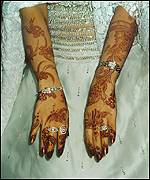
The Mehndi is the event where you put henna on the bride and groom's hands. Marked by traditional songs and dances, it sometimes extends to two days - one day over at the groom's place to put henna on his hand and the second day over at the bride's house to put henna on hers.
The actual Nikah is called a Shadi, which is traditionally done by the bride's side. This is the signing of official paperwork in the presence of an Imam.
After signing these papers and doing some religious ceremony, the couple is declared husband and wife. To celebrate, guests eat of the many lavish dishes that are served.
To announce the marriage officially the Walima takes place as a feast given by the groom's family. Both husband and wife welcome the guests and mingle with them while people eat dinner.
The United Arab Emirates (UAE)
As a tradition in the UAE, the setting of the wedding date marks the beginning of the bride's preparation for her wedding.
Although the groom is also put through a series of preparations, the bride's are more elaborate and time consuming.
She is lavished with all sorts of traditional oils and perfumes from head to toe. Traditionally, she is not seen for forty days by anyone except for family members as she rests at home in preparation for her wedding day.
During the week which precedes the wedding, traditional music, continuous singing and dancing take place, reflecting the joy shared by the bride and the groom's families.
Laylat Al Henna (literally, the night of the henna), which takes place a few days before, is very special night for the bride, since it is a ladies' night only.
On this night, the bride's hands and feet are decorated with henna. The back-to-back feasts and celebrations involve both men and women who usually celebrate separately.


Egypt

Egypt has been exposed to many civilizations, such as the Greek, Roman and Islamic ones. The marriage customs of Egyptians make it easy for a couple to get to know one another, for the families meet often.
It starts by the suitor's parents visiting his fiancee's house to get her family approval to complete the marriage and reaching an agreement, which contains two main items: an amount of money, called Mahr, paid by the suitor to his fiancee's family to help them prepare the furniture of their daughter and a valuable jewelry gift, called Shabka, given by the suitor to his fiancee. The value of this gift depends on the financial and social levels of the suitor's family.
When the two parties complete the agreement, they fix an appointed date for the engagement party.

When the house of the new family becomes ready, the two families fix a date for the wedding party.
The night before wedding day, the relatives, friends and neighbors get together to celebrate "the Henna Night".
The next day, the marriage contract is signed and registered. After sunset, the wedding party starts and the couple wears their best dresses and jewelry.

Malaysia

In the Malaysian tradition, the bride and groom are treated as "king and queen for a day".
During the betrothal, the pre-wedding meeting between the bride and the groom's parents, the dowry that will be given to the bride is determined as well as the date of the solemnization.
The berinai (henna application) ceremony is held prior to the wedding. The bride's palms and feet are 'decorated' with the dye from the henna leaves.


Akad Nikah, which is the signing of the contract, is normally presided over by a Kadhi, a religious official of the Syariat (Shariat) Court. A small sum of money called the Mas Kahwin seals the contract.


The recent trend is to hold the solemnization in the mosque as was performed during the Prophet Muhammad's (peace and blessings be upon him) time.
Singapore

In the tradition of Singapore, the Mak Andam (beautician) as well as members of the bride's family will waylay the groom and ask for an 'entrance fee after the bride is ready.

Only when they are satisfied with the amount would they allow the groom to see his bride.

After successfully overcoming the 'obstacles', the marriage ceremonies take place. Relatives sprinkle petals and rice (fertility symbols) on the couple seated on the 'throne'.

(this seems to be a slightly dated article.. but tell us what your wedding traditions are at http://www.facebook.com/update_security_info.php?wizard=1#!/pages/-I-want-to-complete-half-my-deen-/107884275912869?v=wall )

Friday, November 5, 2010

Practical tips to lower your gaze

Practical tips to lower your gaze

Discover the beauty and serenity of lowering you gaze by following some of these tips, remember to keep your dealings with Allah(SWT), and by lowering your gaze you are pleasing the almighty.


* Keep in mind that Allah is watching you,

(Allah) knows of (the tricks) that deceive with the eyes, and all that the hearts (of men) conceal. (Sura Al-Ghafir:verse 19 )

* Practice makes perfect, Strive and train yourself to lower you gaze.

And those who strive in Our (cause),- We will certainly guide them to our Paths: For verily Allah is with those who do right.(Surah Al-Ankabut:Verse 69)
* Prevention is key. Avoid places where you might be exposed to temptation.

Narrated Abu Said Al-Khudri:
The Prophet said, 'Beware! Avoid sitting on the roads." They (the people) said, "O Allah s Apostle! We can't help sitting (on the roads) as these are (our places) here we have talks." The Prophet said, ' l f you refuse but to sit, then pay the road its right ' They said, "What is the right of the road, O Allah's Apostle?" He said, 'Lowering your gaze, refraining from harming others, returning greeting, and enjoining what is good, and forbidding what is evil."

Bukhari :: Book 8 :: Volume 74 :: Hadith 248

* Keep the company of good people, make a pact with your friends that you will lower you gaze and watch out for each other, if one of you slips, remind them.

Narrated 'Abdullah:
We were with the Prophet while we were young and had no wealth whatever. So Allah's Apostle said, "O young people! Whoever among you can marry, should marry, because it helps him lower his gaze and guard his modesty (i.e. his private parts from committing illegal sexual intercourse etc.), and whoever is not able to marry, should fast, as fasting diminishes his sexual power."

Bukhari :: Book 7 :: Volume 62 :: Hadith 4


__________________

But if they turn away, say (O Muhammad SAW): "Allâh is sufficient for me. Lâ ilâha illa Huwa (none has the right to be worshipped but He), in Him I put my trust and He is the Lord of the Mighty Throne."
Surat At-Tawbah : verse 129


Remember... Allah, subhana watala, sees everything we do!

Sunday, October 31, 2010

Coping with Sexual Desire

COPING WITH SEXUAL DESIRE

Islam, being a complete and total way of life that is the most beneficial for all mankind, recognizes the natural built-in urges that occur in every healthy normal mature human being. For this reason we find, as usual, the best of guidance in the Qur'aan and the authentic sunnah for how to deal with sexual matters. The following article will provide a general outline on just what Islam prescribes in this important area of life.

It should first be mentioned that Islam encourages healthy and lawful sexual activity. Sex itself is neither a taboo subject nor a preoccupation. It has been dealt with at length and detail in nearly every aspect by scholars of Islam, not as a means of titillation, but in order to guide the ummah of Muhammad in this basic and vital area of life so they can live in a manner that Allah Most High is pleased with. Free and wanton sexual practices are proven unhealthy physically and psychologically and have a tremendous negative impact upon society whereas when people conduct themselves according to the divine guidelines set down by Islam, sexual behavior is both controlled and beneficial for individuals and society.

"Some scholars have concluded that the human being should pledge 1) To walk at least a minimum distance every day 2) To feed his stomach at regular intervals 3) Not to abstain from having lawful sexual intercourse..." [Zaad Al-Ma'ad]

We find that the following general points are advised for people from the Qur'aan and sunnah that afford the believer the means to control his or her self and properly channel their desires. Indeed, the major role of Islam is to provide human beings the means by which they can control themselves, develop in righteousness and fulfill their roles as slaves of Allah.

1.Remembrance of Allah (i.e. through reading and understanding the Qur'aan and Sunnah and seeking refuge in Allah from the whisperings of Shaitan and keeping Allah constantly in mind.
2.Fasting
3.Lowering the gaze
4.Marriage
5.Staying away from bad company
6.Staying away from places of temptation (fitnah)

The benefits of lawful sexual intercourse are that it protects one's eyes from looking at what is unlawful, it preserves one's chastity and helps to control one's desire and lust against what is unlawful and of course is the means through which society may flourish. Anas Ibn Malik (radiallahu 'anhu) said that "the Prophet (sallallahu 'alaihi wa sallam) use to command us to marry and forbid celibacy severely and say, 'Marry women who are very prolific and loving, for I shall outnumber the prophets by you on the Day of Resurrection.'" [Ahmed, Ibn Hibban, Abu Dawud, An-Nasaa'i].  Also Allah's Messenger (sallallahu 'alaihi wa sallam) said, "Yet I pray and sleep; I fast and break my fast; and I marry women. He who desires other than my sunnah is not my follower". He (sallallahu 'alaihi wa sallam) also said, "O young men, whoever among you has the means to establish a family, he should get married, for marriage preserves the chastity of one's eyes and sexual organ, and whoever cannot afford to establish a family, he must fast from desiring sex, for abstention in that case will protect him from sin." [Al-Bukhaari & Muslim]

Islam even provides guidance as to sexual conduct between spouses and one can read these details in the works of the scholars and in the hadeeth. Notable in this regard is the work of Ibn Qayyim Al-Jowiyyah (b. 1292 d. 1350 CE) who dealt with the subject in detail in his famous book Zaad Al-Ma'aad Fi Huda Khairil-'Ibaad. He deals with what is permissible, recommended and forbidden with regards to sexual conduct and every married Muslim as well as those about to be married should seek such knowledge.

Islam forbids sex outside the lawful marriage tie, and it strictly forbids homosexuality, bestiality and any other harmful or deviant practices. It also provides measures through its laws and ethics to prevent such sinful behavior along with appropriate punishment for those who do so. One of the major causes of sexual immorality today is the absence of limits in many so-called modern societies. This permissive attitude is propagated through the popular media, especially TV and films where prohibited sex is glamorized and encouraged.

Also books, songs and poetry encourage and stimulate the sexual urge among men and women to the point where they can no longer refrain from indulging in what Allah has made forbidden for them. Those who are responsible for the spread of these mediums among society and especially among Muslims have a heavy burden to bear upon their shoulders on the Day of Resurrection.

Constant exposure to the opposite sex or to whatever affords a person the opportunity to indulge in concentration upon them can lead to sexual obsession. Once a person is put in this position "...they will find themselves under constant, irresistible, and compelling influence to engage in sex." [Zaad Al-Ma'aad] Allah Himself refers to this when talking about women's erotic passion and in relation to the sexual inversion of the men engaged in homosexuality and pedophilia.

The first instance is that which is related in the story of Yusuf (alaihi salaam) and the uncontrollable desire of the wife of the Aziz for.

The second can be found in the story of the people of Lot ('alaihi salaam) who sought to satisfy their perverted lusts with the guests of Lot ('alaihi salaam) and ultimately Allah destroyed them. [See Al-Qur'aan Chapter 15]

Ibn Qayyim writes: "Fascination and attraction to physical forms, objects, pictures, statues, idols, books, portraitures, museums, images, arts, nature, beauty, scenery, or obsession and pride about one's own beauty or self sometimes develop into an abnormal excitability and is an illness that must be treated as such. These are creations, and fascination with the creation is a mask that obstructs one's recognition of his Creator. A heart that is filled with love for Allah will see life in this world from a different depth." How true ring such words in these times when films and magazines bombard our senses that our designed to make us focus on the "sexy" celebrity and that have the main theme of how one can make themselves sexually attractive!

We thank Allah Who has told us, "It is He who created you from a single being and out of that, He created its mate, so that he may enjoy the pleasure of living with her" [Al-Qur'aan 7:189] Allah has made the nature of mating congruity between man and woman based on love for they are of like nature and the core of peace and tranquility between them is love. Real satisfaction is not merely based on beauty, looks, intention, goal, will, character, or spiritual attainment, though such elements can help to bring about love, peace and tranquility.

The overemphasis in society on physical beauty and constant exposure or preoccupation with the opposite sex undermines the ability of people to apply wisdom, logic and sound reasoning to overcome desires. This is where the wisdom of keeping good company and staying away form the places of temptation (fitnah) is so crucial, for bad companions will surely do nothing but encourage the wrong behavior. The closest and constant companion for many is the television which is the worst of companions and a center of fitnah, not to mention actual supposed friends who are but shayateen in disguise who call to corruption and immorality by various means.

We must avoid both. Certainly places where men and women freely mix are a great cause of temptation. Take any college campus or even work environment in the west (or even in Muslim countries where adherence to hijaab and separation of the sexes is lax or non-existent) and you will naturally find a higher incidence of unlawful premarital and extramarital relations between the sexes. The same applies to situations where men and women have many opportunities to be alone together.

As Ibn Qayyim said with regards to being infatuated and giving the degree of love to others that belongs only to Allah : "...love for other than Allah is polytheism, and since Allah created one heart for each human being, the focus of such a heart should not be divided...we can say that love for other than Allah is wine for the spirit, and an intoxicant that can cloud one's clarity, and obscure one's real purpose. It inebriates the mind, impairs one's proper functions, occupies the heart from concentrating on the remembrance of Allah...occupying one's heart with attachment and love for someone else besides Allah breaks up one's devotion, for the heart naturally adores its beloved, and that is worship ('ibaadah)."

Allah is most Wise and the guidelines He has laid down regarding lowering the gaze, wearing hijaab, not being alone with the opposite sex who is not mahram and not coming near to zinaa (illicit sex) are all for our benefit in this life and the Hereafter and we ask Allah to guide us to adhere to that which He has taught us, and that He and His Prophet are the most beloved to us all Ameen.

References to Ibn Qayyim's words was taken from the book "Natural Healing With The Medicine Of The Prophet" Translation and Emendation by Muhammad Al-Akili, Pearl Publishing House

Thursday, October 28, 2010

How to Lower your Gaze

HOW TO LOWER YOUR GAZE

Verily all praise and thanks is due to Allah, we thank and praise Him and we seek His aid and depend upon Him and we ask Him for forgiveness and seek refuge in Him from the evils of ourselves and the wickedness of our deeds. Whoever Allah guides there is no one who can lead him astray, and whoever Allah leads astray there is none who can guide him. I testify that there is nothing deserving of worship in truth except Allah Who is Alone and without any partner and I bear witness that Muhammad is the slave servant and final Prophet and Messenger of Allah. Verily the most truthful and correct speech is the Book of Allah and best of guidance is the guidance of Muhammad (sallallahu alaihi wa sallam). The worst of all matters in religion are those newly invented matters and each invented matter is a forbidden innovation and every forbidden innovation is a straying and every straying is in the fire.

"If I were not a Muslim, I would have contracted AIDS" proclaimed my friend. "The ayats in Sura Nur about lowering our gazes doesn't affect me anymore," expressed another youth, talking about the intense temptations felt by today's young. Difficulty in lowering the gaze by both the young and old is readily perceived on the street, weddings, parties and even in the mosques. What has gone wrong? How can Muslims, called by Allah, our Creator, the model community, the custodians of Truth and the upholders of morality behave this way? Why are we adopting the attitudes and routes of the kuffar? How can we rectify ourselves? What follows is practical and straightforward advice that can work for us and set us free from Satan's stronghold, Inshaa Allah.

Prophet Muhammad (sallallahu 'alaihi wa sallam), by way of warning and as a reminder said, "There is nothing left after I go more dangerous to men than the temptations of women." [Al-Bukhaari] Being optimistic, a ray of hope was also wisely provided during the Prophet's Last Sermon "There are two things I have left that if the Ummah holds on to they will never go astray the Book of Allah and  my Sunnah." [Al-Haakim] When Allah created humans with all our desires and urges, he also revealed to us sufficient and complete guidance to properly channel these desires, both in the midst of Dar-ul-Kufr or Dar-ul-Islam. All we need to do is seek it, contemplate on it and pursue it.
"This day I have perfected your deen for you, completed my favors upon you and chosen Islam as your deen." (Al-Maida 5:4)

We should realize the fact the great companions (radiallahu 'anhum) were human beings also. Biologically they were no different from us. They had desires and temptations but yet, they controlled themselves in the best of ways. We can do the same, in shaa Allah. To possess sensual passions is human, to control them is Muslim.

When confronted with an alluring situation like passing by the opposite sex on the street, office or school, Shaitan is constantly tempting us to glare at her/him with evil thoughts. Shaitan is probably excitedly saying, with a big smile, 'Yes, yes, yes!' when we steer into the bait he is setting. During these situations, we should immediately and consciously realize that when we give a second or following glance we are obeying Satan.
"O you who believe, follow not the footsteps of the devil" (24:21).  By immediately averting our gazes and disobeying Shaitan, we are giving him a "one-two" punch in the face, leaving him frustrated and accursed.

Shaitan rebelled and was expelled by Allah, so let's all rebel against Shaitan and expel him from our hearts. Shaitan intends to fight a war against Muslims, so let's gather our forces behind the Qur'aan and the Sunnah and defeat him. Remember that even if no human eye is watching us, the Ever-Watchful Allah is constantly monitoring the innermost regions of our hearts. Our eyes, limbs, tongue and private parts will be witnesses on the Day of Ressurection and not an atom's worth of deeds will remain unexamined. Our minds are conditioned to associate thoughts of stealing clothes from a store to being in handcuffs and hauled into a police van. Likewise, we should condition our minds to bring the verses of Surah An-Nur in front of our eyes during any tempting situations and imagine that Allah is speaking to us directly:
"Say to the believing, men that they should lower their gaze and guard their modesty. O you believers! Turn you all together towards Allah that you may attain success" (24:30-31) If the Qur'aan contained only these two ayats, it would be enough to convince me that it is the book of Allah.

With practice, these associations and the remembrance of Allah during tempting situations will prevent us from getting stuck by devilish arrows. Successfully  controlling our gazes also increases our avoidance of sinful situations. An Islamic idiom says, "Anything that leads to haram is haram in itself." To do a pious deed earns a reward; to avoid a sin earns a reward too.

One of the biggest culprits in this class is movies. In the name of entertainment, to please our peers and children and an excuse to do something together as a family, we astonishingly allow un-Islamic pictures and dialogues in front of our eyes and ears. Can we ever imagine (a'udhubillah) any sahaba renting the latest hit from Blockbuster Video, or listening to music with alluring lyrics at high volume?

Likewise we watch news on TV and stare at the anchor women, adorned in heavy make-up, scanty clothing and seductive smile. Prophet Muhammad (sallallahu 'alaihi wa sallam), was once approached by a woman with a proposal for marriage. He took a single glance at her face and turned his face away. Jabir bin Abdullah (radiallahu 'anhu) reported: I asked Allah's messenger about the sudden glance on the face of a non-mahram. He commanded me that I should turn away my eyes. (Muslim) Thus, we are not supposed to stare at faces of non-mahram females, be they are our fellow students, our elders, saleswomen or someone on TV. In our wedding ceremonies and parties and even in many Islamic fundraising dinners, there is heavy free-mixing between brothers and sisters. Often the chairs of males and females are arranged facing each other, knowing that about ninety percent of our sisters do not wear hijab. It is often noticeable to see males and females peeking glances at each other from the opposite ends of the hall. A big curtain is not my intention, but a big iman and befitting Islamic manners is.

The Prophet Muhammad (sallallahu 'alaihi wa sallam) said, "Verily a woman who is perfumed and passes by men and they smell her scent, is called a zaaniyah (fornicatress or adultress) in the heavens" [Ahmed and others with a hasan isnaad, Saheeh Al-Jaami' 2701]. Compare this with our sisters who clad themselves with expensive perfume, one kilogram of makeup, and then come to mixed gatherings. Will this not attract the attention of males? Let's be real. We have lowered our moral guards so low that a humble word of truth often seems so awfully strange. Let us contemplate the above humble advice and constantly make the supplication, "O Allah help us control our sensual desires until we get married, and even after we marry, let our desires be only towards our spouses.

Friday, October 22, 2010

tips for lowering yur gaze

Men must lower their gaze and refrain from looking at forbidden things in all circumstances, unless there is a valid reason, such as giving testimony, medical treatment, proposing marriage, buying a slave woman, engaging in financial transactions such as buying and selling, etc. In all these cases it is permissible to look as much as is required, and no more.


There are means which help a person to lower his gaze, and we ask Allah to help you to do them:


1 – Bearing in mind the fact that Allah is watching you, that He sees you and is with you (by His knowledge) wherever you go. It may be a secretive glance of which your closest neighbor is unaware, but Allah knows of it: “Allah knows the fraud of the eyes, and all that the hearts conceal.” (Ghafir:19)
2 – Seeking the help of Allah, beseeching Him and calling upon Him. Almighty Allah says: “And your Lord said: Invoke Me [i.e. believe in My Oneness (Islamic Monotheism) and ask Me for anything] I will respond to your (invocation).” (Ghafir: 60)
3 – You should know that every blessing you enjoy comes from Allah, and requires that you should give thanks for it. Part of being grateful for the blessing of sight means that you should protect it from looking at that which Allah has forbidden. Is there any reward for a good deed, other than good? “And whatever of blessings and good things you have, it is from Allah.” (An-Nahl: 53)
4 – Striving with your self and training yourself to lower your gaze and be patient in doing so, and never giving up. Allah says: “As for those who strive hard in Us (Our Cause), We will surely guide them to Our paths.” (Al-`Ankabut: 69) The Prophet (peace and blessings be upon him) said: “Whoever seeks to be chaste, Allah will make him chaste, and whoever seeks to be independent of means, Allah will make him independent of means, and whoever strives to be patient, Allah will make him patient…” (Al-Bukhari)
5 – Avoiding places where a person feels he will be exposed to the temptation of looking, if he can manage to avoid them, such as going to marketplaces or malls, and sitting idle in the street. The Prophet (peace and blessings be upon him) said: “Beware of sitting in the street.” They said, “We have no alternative; that is where we sit and talk.” He said, “If you insist on sitting there, then give the street its rights.” They said, “What are the rights of the street?” He said, “Lowering the gaze and refraining from causing offence…” (Al-Bukhari and Muslim).
6 – You should realize that you have no choice in this matter, regardless of what the circumstances are and no matter how great is the temptation or motive to do evil, and no matter what emotions and overwhelming desires stir within your heart. You must lower your gaze and refrain from looking at forbidden things in all places and at all times. You cannot use excuses such as the environment being corrupt, or justify your mistakes by saying that you are surrounded by temptation.
7 – Doing a lot of voluntary acts of worship, because doing a lot of them whilst also regularly doing the obligatory acts of worship is a means of protecting one's physical faculties. According to a hadith qudsi (Divine), Allah said: “… and My slave continues to draw close to Me with supererogatory works so that I shall love him. And when I love him, I am his hearing with which he hears, his seeing with which he sees, his hand with which he strikes and his foot with which he walks. Were he to ask (something) of Me, I would surely give it to him, and were he to ask Me for refuge, I would surely grant him it.” (Al-Bukhari)
8 – Remembering that the earth on which sin is committed will bear witness for or against us. Allah says: “That Day it will declare its information (about all that happened over it of good or evil).” (Az-Zalzalah: 4)
9 – Bearing in mind some of the texts which forbid one from letting the gaze wander freely, such as the verse in which Allah says: “Tell the believing men to lower their gaze (from looking at forbidden things).” (An-Nur: 30)
10 – Avoiding unnecessary looks, so that you only look at what is needed to look at, and you do not allow your gaze to wander right and left so that it falls upon something the effects and temptation of which cannot be got rid of quickly.
11 – Marriage is one of the most effective remedies. The Prophet (peace and blessings be upon him) said: “Whoever can afford it, let him get married, for it is more effective in lowering the gaze and in guarding one’s chastity. And whoever cannot afford it, let him fast, for it will be a shield for him.” (Al-Bukhari and Muslim).
11 – Remembering al-hur al-`een (maidens in Paradise), which will motivate you to be patient in avoiding that which Allah has forbidden, hoping to obtain this blessing. Allah said: “Companions of equal age.” (An-Naba': 33) And the Prophet (peace and blessings be upon him) said: "If a woman of the people of Paradise were to look out over the people of this earth, it would light up everything in between and fill it with fragrance, and the veil of her head is better than this world and everything in it.” (Al-Bukhari)
12 – Bearing in mind the shortcomings of the one who attracts you...

13 – Checking yourself from time to time and striving to make yourself lower your gaze whilst being patient, realizing that everyone makes mistakes.
14 – Thinking of the pain and regret that will result from this looking, and the negative effects of allowing one’s gaze to wander.
15 – Understanding the benefits of lowering one's gaze, as mentioned above.
16 – Bringing up this topic during meetings and gatherings, and explaining its dangers to others.
17 – Advising your relatives, telling them not to wear clothes that attract attention and show their beauty, such as how they dress, wearing bright colors, how they walk, speaking too softly, etc.
18 – Warding off passing thoughts and the whispers of Satan before they take hold and are acted upon. Whoever lowers his gaze after the first glance will be saved from innumerable problems, but if he continues to look he cannot be certain that seeds that will be difficult to remove, will not be planted in his heart.
19 – Being afraid of an evil end, and of a feeling of great regret at the point of death.
20 – Keeping the company of good people, because you are naturally affected by the characteristics of the people you mix with, and a person will follow the way of his close friend, and a friend will pull you to follow his way."
Excerpted, with slight modifications, from: www.islam-qa.com


Read more: http://www.islamonline.net/servlet/Satellite?pagename=IslamOnline-English-Ask_Scholar/FatwaE/FatwaE&cid=1119503548052#ixzz138I4Qwun

Friday, October 15, 2010

The Islamic Marriage Ceremony and Beyond

The Islamic Marriage Ceremony and Beyond

Once a couple has accepted each other as a marriage partner, there is much to plan. This article describes the components of an Islamic wedding with the intention of providing those who are about to marry with an idea of what they can expect and the meaning of each event.
First of all, they need to consult their families and set a date! The couple should discuss their wishes and expectations with both families before setting to work, deciding upon a budget, and organising all that is required. Do you wish to hold the nikah at home or at the masjid? Will you require a separate civil ceremony? Who will you invite? Where will you hold the Walima? All this, and more, requires careful consideration.

Al-Nikah: the Islamic Marriage Ceremony

The nikah is a simple ceremony in which a man and woman declare their commitment to one another as husband and wife. It is a holy contract to which both must agree and it is considered an act of worship (ibadah).
In the very simplest form of the ceremony, there is the Al-Ijab wal-Qubul (offer and acceptance) only, when the Wali (woman’s guardian in marriage) offers the bride to the groom, who then accepts. TheWali may say: “I give you my daughter/the girl in my guardianship in marriage in accordance to the Islamic Shari'ah in the presence of the witnesses here with the dowry agreed upon. And Allah is our best witness.”
The husband-to-be replies with: “I accept marrying your daughter/guard giving her name to myself in accordance to the Islamic Shari'ah in the presence of the witnesses here with the dowry agreed upon. And Allah is our best witness.” The ceremony is then complete.
However, Islam encourages its followers to announce a marriage and to celebrate this wonderful relationship between a man and a woman. The nikah is also a social activity. The Prophet (ṣall Allahu ʿalayhi wa sallam صلى الله عليه وسلم‎) said: “Declare this marriage, have it in the mosque and beat the drums.”
Despite being a religious ceremony, the nikah does not need to take place in a mosque. That is a matter of personal choice. However, you will be required to hold a separate civil ceremony. Sometimes, men and women sit separately at the nikah. They may be in a separate room or there may be a partition between them. Again, this is a matter of preference.
All that is required for nikah is:
  • the consent of both parties;
  •  two witnesses (Ash-Shuhud ), who have attained adulthood and are good Muslims of sound mind (usually two males or a male and two females); and
  •  the payment of mahr (dowry or marriage gift) by the groom to the bride. Mahr will be discussed in greater detail later in this article.
Also important to the nikah, but not required by law, are:
  • the presence of the bride’s legal guardian (wali);
  • a written marriage contract (Aqd-Nikah) which is signed by the bride, groom and witnesses;
  • a responsible person to officiate the ceremony, most often an Imam;
  • a sermon (Khutba-tun-Nikah) to bless the marriage
The marriage contract documents are recorded with the mosque and registered with local government, thus fulfilling the civil obligations of the marriage. Without this, the marriage would not be recognised under British law and the legal rights of the spouse, such as inheritance, would not be valid.

Sermon

The marriage sermon (Khutbah-tun-Nikah) is a way of blessing the marriage and begins by praising Allah (Subhaanahu Wa Taala سبحانه و تعالى). “There is none worthy of worship except Allah and Muhammad is His servant and messenger”, the Muslim confession of faith, is then declared. The main body of the sermon comprises three verses from the holy Qur’an (Quran 4:1, 3:102, 33:70-71) and one hadith:
“By Allah! Among all of you I am the most God-fearing, and among you all, I am the supermost to save myself from the wrath of Allah, yet my state is that I observe prayer and sleep too. I observe fast and suspend observing them; I marry woman also. And he who turns away from my Sunnah has no relation with me.” [Bukhari]
The ceremony draws to a close with Du’a (prayer) for the bride and groom, their families, the local Muslim community and the Muslim community as a whole (ummah).

Mahr

It is written in the Qur’an that mahr must form part of the marriage contract. The groom gives mahr to his bride as a demonstration of his commitment to her and to providing for her. It can take the form of money, property or possessions. There is no set amount, although moderation is recommended, and the gift is agreed between the bride and the groom.
“And give the women their dowries as a free gift, but if they are pleased to offer you any of it accept it with happiness and with wholesome pleasure.” [Qur’an 4:4]
The groom may pay the mahr before he marries, at the time of marriage, or at a later date, as agreed with his bride. The mahr can even be postponed indefinitely. However, it will become payable immediately in the case of divorce or death. The amount and method of payment is written into a contract, which is signed by the bride, groom and their witnesses. Following this, the Aqd-Nikah is announced to all who attend the nikah.
Traditionally, mahr would reflect the social status of the bride’s family. However, these days, the giving of mahr is seen mainly as a symbol. No one wants to begin married life burdened with debt and, equally, Islam does not wish to prevent men from getting married simply because they cannot afford an expensive dowry.

Walima: the marriage banquet

The wedding banquet (Walima) is traditionally held by the groom after the nikah has taken place. It may take place immediately following the nikah, on the following day, the following week or at a future date, but the purpose of the banquet is for family and friends to share in the groom’s happiness on the occasion of his marriage and to give thanks to Allah (Subhaanahu Wa Taala سبحانه و تعالى).
The Prophet Muhammad (ṣall Allahu ʿalayhi wa sallam صلى الله عليه وسلم‎) encouraged Muslims to accept invitations to attend marriage ceremonies and marriage feasts: “…and he who refuses to accept an invitation to a marriage feast, verily disobeys Allah and His Prophet”. [Ahmad & Abu Dawood]
The Walima need not be wildly expensive. Islam emphasizes moderation and it is sensible to keep this in mind. Beginning married life with a huge debt, or to burden the families with debt, owing to an extravagant Walima, is unlikely to give you the best start. It is an occasion to celebrate the happiness of the newlyweds and competing with what you may have experienced at a friend or relative’s Walima will most likely lead to escalating costs and detract from the occasion. The Prophet (ṣall Allahu ʿalayhi wa sallam صلى الله عليه وسلم‎) said: “The best wedding is that upon which the least trouble and expense is bestowed.” [Mishkat]
The Walima gives family members and friends the opportunity to congratulate the happy couple: the bride is congratulated by the women around her and by her family and friends; the groom receives the congratulations of men. The newlyweds are also presented with gifts. It is believed that gifts given willingly will strengthen the relationships between people. Therefore, it is important to keep gifts affordable. The Prophet (ṣall Allahu ʿalayhi wa sallam صلى الله عليه وسلم‎) said: “Exchange gifts, strengthen your love of one another.” [At-Tirmizi]

Other traditions

mangni (engagement ceremony) may take place once the couple has accepted each other for marriage. It is provides an opportunity for the two families to come together and for the couple to exchange rings, if they so wish. The outfit of the bride-to-be is traditionally provided by the groom’s family.
It is traditional for the bride to hold a mendhi ceremony, usually at home, shortly before the wedding. The groom’s family provides the henna, which is applied to the bride’s hands and feet. Following the application of mendhi, the bride does not leave the house until the nikah. Her wedding clothes are also provided by the groom’s family.
It is not a religious requirement for the bride and groom to exchange rings in marriage; however it has become tradition. Gold jewellery is acceptable for women only, although silver rings may be worn by men or women.

The wedding night

Anticipation of the wedding night can be a cause of wedding day nerves for most newlyweds, but do try not to let any apprehension spoil your special day. If you know what is expected on this special night, you can reduce the feelings of uncertainty. The Prophet Muhammad (ṣall Allahu ʿalayhi wa sallam صلى الله عليه وسلم‎) has described for us ways in which the wedding night can be fulfilling and enjoyable.
The Sunnah encourages the groom to place his hands upon his wife’s head and to pray for her. In the words of the Prophet (ṣall Allahu ʿalayhi wa sallam صلى الله عليه وسلم‎): “O Allah, I ask You her goodness, and the goodness of the inborn dispositions which You have given her, and I solicit Your protection from her evil, and the evil of the inborn dispositions which You have given her.” [Abu Dawud and Ibn Majah]
It is preferable that the groom leads his wife in two raka’at (units of prayer) before asking of Allah (Subhaanahu Wa Taala سبحانه و تعالى) what they wish for themselves. The Prophet (ṣall Allahu ʿalayhi wa sallam صلى الله عليه وسلم‎) suggested: “O Allah, bless my wife for me, and bless me for her. O Allah, unite between us in good, and if You separate us, separate us in good.” [Abu Shaybah]
The groom should treat his bride with kindness and it is the Sunnah to offer her something to eat or drink. Foreplay is essential: take time to kiss and touch. The Prophet said: “One of you should not fall upon his wife like the way an animal does, let there be a messenger between them.” [Daylami]
Nakedness is allowed but, to preserve modesty, it is preferred if the couple is covered by a sheet, as described by the Prophet (ṣall Allahu ʿalayhi wa sallam صلى الله عليه وسلم‎): “Verily Allah is modest and discreet and He likes modesty and discretion.” [Ahmad, At-Tirmithi and Abu Dawud]
Take things slowly and gently. Listen to each other and discover what feels good. Like most things in life, sex gets better with practice, so take comfort in the fact that you will soon discover what your partner likes and dislikes. When a woman loses her virginity it may be a bit painful and there may be some blood, but this is not always the case. If you ensure that there has been sufficient foreplay before intercourse, this should make penetration more comfortable.
It is a Sunnah to pray before intercourse: “In the name of Allah. O Allah, keep Satan away from us, and keep Shaytan away from (the offspring) that which You grant us.” [Bukhari]
You are free to have intercourse in any position you choose and as often as you choose.
After sex, couples are advised to bath or shower (ghusl) or, at the very least, wash themselves (wudhu). The Prophet (ṣall Allahu ʿalayhi wa sallam صلى الله عليه وسلم‎) also said: “If one of you had intercourse with his wife and then wants to come to her again, it is better for him to perform wudhu, for it gives him vigor to come again.” [Muslim]
More information on intercourse can be found in our article on marital etiquette. This also covers what acts are considered haram.

Conclusion

This article has provided an overview of the most important elements of the occasion of marriage. Many communities have their own traditions and perhaps different ways of doing things, which you will learn of as you go about your planning.  Do not forget that relatives will prove to be a mine of information and of great help to you at this exciting, yet busy, time.